Galapatours logo 1200px svg

Bestseller

All Dates & Prices

Cruises

Galapagos

Info

Home

Bestseller

Galapatours

Santiago, Isabela & Fernandina

Galapatours

South & Central Islands Galapagos Cruise

Galapatours

Santiago, Isabela & Fernandina

Galapatours

Southern, Central, North & Western

Galapatours

Western Galápagos Cruise

Galapatours

Center & Southeast Galápagos

All Dates & Prices

Cruises

Information

Diving Cruises

For Deal Hunters

For Families

For Solo Travelers

Gay & LGBT Cruises

Last Minute Offers

Our Selection Of The Best Routes

Search by Date & Price

Ship Type

All ships & How to pick the best

Larger Ships (>50 Passengers)

Motor Catamarans

Sailing Catamarans

Sailing Yachts

Yachts

Travel Style

Budget Cruises

Classic Cruises

Premium Cruises

Luxury Cruises

Galapagos

Islands: Center

Baltra

Bartholmew

Genovesa

Marchena

North Seymour

Pinzón

Rábida

Santa Cruz

Santa Fe

Santiago

South Plaza

Islands: East

Española

Floreana

San Cristóbal

Islands: West

Darwin (For Divers Only)

Fernandina

Isabela

Wolf (For Divers Only)

Info

Information

All Islands and Highlights

What our travelers say

Our Team & Our Passion

Add-Ons

Answers to over 80 FAQ

Flights

Free Guidebook Download

Galapagos Wildlife Guide

Sustainable Tourism

Weather in the Galapagos

YouTube: Galapagos Expert Talks

Your Advantages When Booking With Us

Why book with us?

Flexible Booking Conditions

No Hidden Fees

Travel Insurance for EU and CH Residents

Unbiased Recommendations

Your money is protected

Contact us

Weekdays from 15:00 to 20:00 CET

$
​
​
$
​
​

Sign up for our Galapagos newsletter

Get travel inspiration and exclusive deals delivered straight to your inbox.

​
Galapatours logo 1200px svg

Budget Ships

Aida Maria

Angelito

Aqua

Danubio Azul

Golondrina

Nemo I

Classic Ships

Aggressor III

Anali

Archipel I

Beagle

Bonita

Eden

Estrella del Mar

Premium Ships

Anahi

Angel

Beluga

Cachalote Explorer

Calipso

Coral I + II

Eco Galaxy

Luxury Ships

Alia

Aqua Mare

Cormorant II

Elite

Endeavour II

Endemic

Evolution

Further Cruise Links

The Best Galapagos Cruises

Galápagos Honeymoon Cruises

Galápagos Cruises with French Speaking Guides

Galápagos Cruises with German Speaking Guides

4 Day Galápagos Cruises

5 Day Galápagos Cruises

7 Day Galápagos Cruises

Further Information

About Galapatours

B2B Deals

Careers

Join our team!

Terms & Conditions

ventura TRAVEL

Reservations

🇺🇸 +1 347 674 0913

🇬🇧 +44 20 4525 9654

🇩🇪 +49 30 30809199

🇫🇷 +33 1 86 26 29 65

Contact Form

service(at)galapatours.com

Weekdays from 15:00 to 20:00 CET

Galapagos Fur Seal

Galapagos Fur Seal

Endangered night-time fisher of Galápagos

What you need to know about the Galapagos Fur Seal

The Galápagos Fur Seal is only found on the rocky western shores of the Galápagos islands, and nowhere else. Sadly, their population is reducing and they are now officially listed as “endangered”. As they are most active at night when they hunt, they are less common to see than the Galápagos Sea Lion, but there are about the same number remaining in the wild - approximately 40,000 animals. On a Galapatours cruise our expert naturalists and boat captains will maximise your chances of seeing these unique creatures on your journey around the islands.

The Galápagos Fur Seal is the smallest of the “eared seals”, with typical males growing to under 5ft (1.5m) in length and 130lb (60kg) in weight. They are often confused with the Galápagos Sea Lions as they look similar, but there are some key differences. Apart from their overall much smaller size, they have large, slightly bulging eyes which aid them when hunting at night and prominent ears that usually stick out from the head.

As nocturnal hunters, the Galápagos Fur Seals spend most of their day sleeping in small colonies on the rocky shorelines. In the middle of the day they will often move into shade to avoid overheating. The seal’s fur was prized by hunters, and they were almost hunted to extinction in the early 20th century until protected under Ecuadorian Law, and then further protected by the formation of the Galápagos National Park in 1959.

During the seals’ breeding season the females will lay claim to a small territory where she will breed and have her pup. The Galápagos Fur Seal has the lowest fertility rate of all the seals, each mother only ever giving birth to one pup. This is one of the reasons why the species is endangered, as any ocean warming caused by El Nino events can cause devastation amongst the population. As an example, in a 1983 El Niño event almost all that year’s young fur seals were lost along with a third of adult females and almost all of the large territorial males.

Interesting facts about Galapagos Fur Seal

Galápagos Fur Seals only spend about 30% of their time in the water

Adult males will defend their breeding territory fiercely, not entering the water to eat until they are near collapse

Galápagos Fur Seal pups aren't weaned until they are 2 or 3 years old

Galápagos Fur seals were almost hunted to extinction in the 20th century for their skins

Pictures of Galapagos Fur Seal

Galapagos Fur Seal
Galapagos Fur Seal
+3
Galapagos Fur Seal

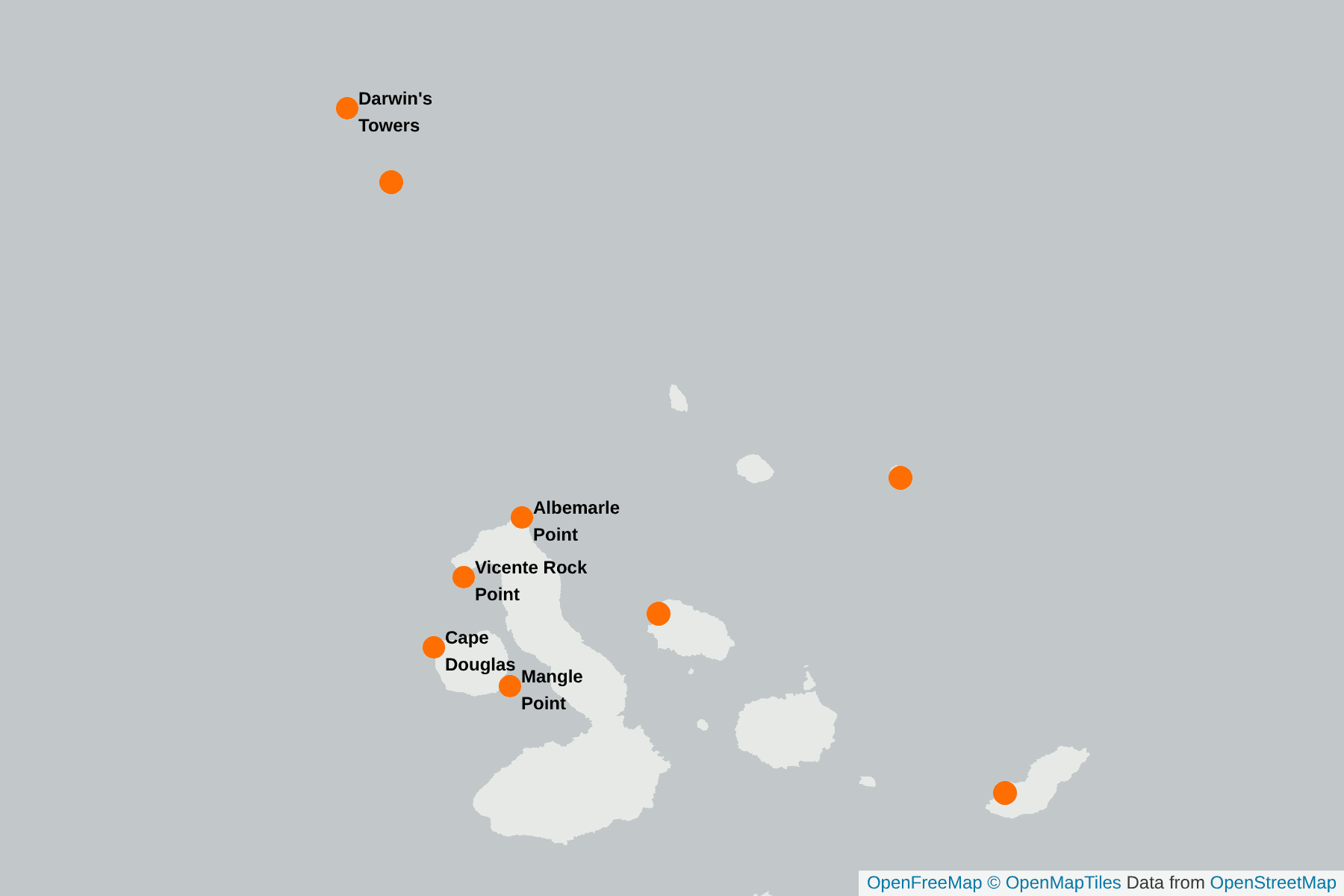
Highlights where the Galapagos Fur Seal can be seen

Albany Rock
Albany Rock

Albany Rock is a small crescent-shaped outcrop just off the northwest coast of Santiago Island.

The dive at Albany has a maximum depth of around 100ft and visibility here is from 40 – 70 feet, depending on time of year. There's a moderate current that shifts from north to south with the tides, and also some moderate surge.

This is a great dive site to swim with Galápagos Sea Lions who often come and say hello. There are a host of tropical fish to be seen here, as well as species such as manta and stingrays, Galápagos green turtles and several species of sharks. The rocky bottom and geological formations provide a great habitat for a wide variety of marine life and make for enjoyable exploring under water.

Albemarle Point
Albemarle Point

Located on the remote northern tip of Isabela Island, Albemarle Point has the ruins of an abandoned US radar base from World War II. This infrequently visited site is only accessible by panga, but this gives you the opportunity to see the nesting sites of the critically endangered and unique Galápagos Flightless Cormorant.

Living alongside the Cormorants is a colony of the largest Marine Iguana species anywhere in the Galápagos, and you will be able to see these remarkable creatures as they feed at the water's edge or dive into the waves.

Because there are no landings allowed here, and thanks to its remoteness, this is one of the most unspoiled areas in the Galápagos, with little impact from introduced species. From the boat, you will also get a great view of a smooth undulating lava flow that made its way to the water's edge.

Buccaneer Cove
Buccaneer Cove

Sited on the northwest coast of Santiago Island, Buccaneer Cove wasn't named as a romantic fancy, but because it actually was used extensively by pirates, privateers, buccaneers and whalers to set anchor and head ashore.

Of all the Galápagos Islands, Santiago was most frequently used as a stop over as it provided easy access to fresh water, wood, and meat. Used since the 1600s as a staging point, the easy-to-catch Giant Tortoises that lived here became a useful source of protein for the sailors. There was a more strenuous journey required up to the highlands in search of water, but the sheltered cove made this a better location than some of the more open coast elsewhere.

Today the steep cliffs above the cove are filled with nesting seabirds, wheeling in the air above the deep red sands of the beach. This is a good site for snorkeling or to stroll along the beach drinking in the sights and sounds of the Galápagos, and you will often find yourself sharing the sand and rocks with sea lions or Galápagos Fur Seals.

Cape Douglas
Cape Douglas

A dive in Cape Douglas off the west coast of Isabela Island is a fantastic opportunity to see a wide array of marine life, both above and below the surface of the water.

As you prepare for your dive you can see Galápagos Flightless Cormorants, Galápagos Penguins and Galápagos Marine Iguanas - all species you cannot see anywhere else in the world except this archipelago.

As you enter the water, you may have the opportunity to admire the powerful swimming ability of the marine iguanas as the bigger males feed on the rocks deeper under the surface.

Other species you may see in the water include Red-lipped Batfish, Horn Sharks and Mola Mola, and sometimes Baleen Whales are seen here gliding through the water.

If you have particular species that you are keen to see, contact one of our Galápagos experts today who can help you choose an itinerary that will best meet your requirements.

Darwin Bay
Darwin Bay

Darwin Bay is a must-visit site for birdwatchers. Starting with a landing on a beautiful white coral beach you are able to follow an easy half-mile trail that will take you through bird-filled mangroves. Species that can be seen on this part of the trail include Nazca Boobies, Galápagos red-footed Boobies, and Swallow-Tailed gulls.

As the path continues you will find tidal pools - favourite spots for Galápagos Sea Lions to lazily swim and play. At the path's end you will come to the top of a cliff which will reward you with a spectacular view.

Darwin's Arch / Towers Diving
Darwin's Towers

Huge schools of hammers and Galápagos sharks, whale sharks, Mantas: Darwin's Towers (formerly: Darwin's Arch) is arguably one of the world's best diving sites.

Located just off the southeast tip of Darwin Island, the islet of Darwin's Towers (formerly known as Darwin's Arch, but the arch collapsed in 2021) is a fantastic marine wonderland. The main attractions are the whale sharks and hammerhead sharks that often gather here. But there are many other species you can find - green turtles, majestic manta rays, dolphins, large schools of fish, and other species of sharks are all frequent encounters.

We have met divers with over 1000 logged dives that still called it the single best diving site of their life! If you have any particular species that you are keen to see on your dive, contact one of our Galápagos experts today, and we can advise on the best dive itinerary to suit your requirements.

Egas Port
Egas Port

Puerto Egas (Port Egas) is a sheltered landing site at the southern end of James Bay on the northwestern coast of Santiago. This landing site is the trailhead for two hiking paths.

The first trail runs along the coast to visit the so-called "Fur Seal Grottos". The Galápagos Fur Seals like to seek shade from the equatorial sun, and they prefer rocky shores with caves or other nooks and crannies in which they can keep cool. The grottos here are perfect for them, and the tidal pools are also popular with Galápagos Marine Iguanas who can be seen feeding in and around them.

The second trail from Egas Port heads inland to the "Salt Mine Volcano". This hike is just under 2 miles long and takes you to the rim of a salt mine crater. This "mine" is actually a small volcanic cone that is filled with a salt water lagoon that dries up in the dry season. At several points in the 20th century individuals or companies attempted to mine salt from it, but without commercial success. The name of your landing site is after the owner of the last company to try salt mining here, Hector Egas.

The lagoon is often home to Galápagos flamingos and other birds, and the wonderful Galápagos Hawk can often be seen circling above this area.

Fondeadero
Fondeadero

This is one of the only places in the whole Galápagos where night diving is allowed. Fondeadero means "anchoring site", and it's well names - this is the perfect place for a night dive as it's protected from the winds and currents. This makes it possible to enjoy night diving, and to witness a whole new side to Galápagos' undersea world.

Highlights to a night dive here include the chance of seeing the see glow gently with an eerie light, thanks to the bioluminescence of tiny plankton in the water when conditions are right. You've also got an excellent chance of being joined by Galápagos Fur Seals on your dives here.

Galapagos Sea Lion
Isla Lobos Dive Site

One of the best spots in Galápagos to observe sea lion pups, trumpet fish and blue footed boobies.

Lobos Island is named after the colony of Galápagos Sea Lions that live here, but they aren't the only native Galápagos species that calls this narrow island home. In the water, you will find Fur Seals fishing Blue-Footed Boobies, Trumpet Fish, Green Turtles, Rays and white-tip reef sharks. With a bit of luck, you might also spot marine iguanas, although they are not hugely common here!

Lobos Island
Lobos Island

Lobos Island is named after the colony of Galápagos Sea Lions that live here, but they aren't the only native Galápagos species that calls this narrow island home. You can see Galápagos Fur Seals basking here, and there is a nesting colony of Blue-Footed Boobies that come to Lobos each year to raise their chicks.

There are one or two short hiking trails that lead into the center of the island, and this is always a peaceful place to visit. Galapatours visitors tell us it's one of their favorite visitor sites to just sit and soak up the Galápagos atmosphere.

Back on the beach, the swimming and snorkeling is wonderful, and thanks to the island's position close to the main shore of San Cristobal, the channel between them is sheltered and the turquoise water is crystal clear.  This is a Galapatours favorite spot, so speak to one of our Galápagos specialists if you want help choosing an itinerary that includes a visit to this special place.

Mangle Point
Mangle Point

Mangle Point (known as Punta Mangle locally) is one of the newer visitor sites that have been authorized by the Galápagos National Park, and this one is excellent for snorkeling.

Mangle Point is on the eastern side of Fernandina and is a natural inlet which forms a sheltered area that's filled with wildlife, both under the water and on the coast. There's no landing here, and you will be snorkeling direct from your boat.

Among the species that you are likely to see are Galápagos rays, sea lions, green turtles, and sharks. As you drift along by the mangroves you can also see flightless cormorants, pelicans, Darwin's Finches, and many more species that your Galapatours expert guide will identify to you.

North Islet / La Banana

North Islet is a small outcrop just off the north coast of Wolf, and because of the wall's shape it's known to locals as "the banana"!

This is a stunning sheer wall with caverns, tunnels and other wonderful rock formations. Depth here ranges from 30 to 120ft and the visibility is usually excellent, varying from 40 to 80ft depending on season. There is always a moderate to heavy current here.

A superb site for spotting Galápagos sharks, hammerheads, manta rays, green turtles and a wide range of fantastic Galápagos marine life.

Prince Philip's Steps

Named after Prince Philip, the husband of Queen Elizabeth II, who visited the Galápagos Islands twice, the Prince Philip's Steps pier uses natural rock formations to allow you to land and admire the variety of seabirds that inhabit Genovesa. With careful steps on the wet and slippery lower rocks, you begin your hike near a small colony of Galápagos sea bears before reaching the beautiful vantage point further up with views of the lava plains.

The birdlife will surround you from all sides and you will enjoy the sight and sounds of many wonderful species, including blue-footed boobies, red-footed boobies and Nazca boobies, but also small Galápagos owls and Galápagos pigeons.

Vicente Rock Point
Vicente Rock Point

Galapatours clients regularly rate Vicente Rock Point as one of the best snorkeling and SCUBA diving sites in Galápagos, or perhaps even in the world! There is no landing here, and snorkeling is done directly from the boats. The scenery around the Point is stunning - the remains of two ancient volcanoes made this formation, and the cliffs and caves around the bay provide an amazing backdrop.

The bay is well sheltered from ocean swells, making it ideal for snorkelers of any experience. The cold-water currents bring a rich stock of food to these waters, and the bay around Vicente Rock Point is often home to feeding frenzies, with groups of whales, dolphins, Galápagos Sea Lions, tuna, Blue-footed Boobies and other marine birds all feeding together, making for spectacular sights.

Many boats also take visitors on a panga ride along the shore, offering the chance to explore some of the caves and to encounter some of the other species such as Galápagos Flightless Cormorants and a small colony of Galápagos Fur Seals.

Our trips to spot the Galapagos Fur Seal

Hitomi

Your contact

Hitomi

Call now

+1 347-674-0913

Weekdays from 15:00 to 20:00 CET

​
​
​
​
​
​
Hitomi