Galapatours logo 1200px svg

Bestseller

All Dates & Prices

Cruises

Galapagos

Info

Home

Bestseller

Galapatours

Santiago, Isabela & Fernandina

Galapatours

South & Central Islands Galapagos Cruise

Galapatours

Santiago, Isabela & Fernandina

Galapatours

Southern, Central, North & Western

Galapatours

Western Galápagos Cruise

Galapatours

Center & Southeast Galápagos

All Dates & Prices

Cruises

Information

Diving Cruises

For Deal Hunters

For Families

For Solo Travelers

Gay & LGBT Cruises

Last Minute Offers

Our Selection Of The Best Routes

Search by Date & Price

Ship Type

All ships & How to pick the best

Larger Ships (>50 Passengers)

Motor Catamarans

Sailing Catamarans

Sailing Yachts

Yachts

Travel Style

Budget Cruises

Classic Cruises

Luxury Cruises

Premium Cruises

Galapagos

Islands: Center

Baltra

Bartholmew

Genovesa

Marchena

North Seymour

Pinzón

Rábida

Santa Cruz

Santa Fe

Santiago

South Plaza

Islands: East

Española

Floreana

San Cristóbal

Islands: West

Darwin (For Divers Only)

Fernandina

Isabela

Wolf (For Divers Only)

Info

Information

Add-Ons

All Islands and Highlights

Answers to over 80 FAQ

Flights

Free Guidebook Download

Galapagos Wildlife Guide

Our Team & Our Passion

Sustainable Tourism

Weather in the Galapagos

What our travelers say

YouTube: Galapagos Expert Talks

Your Advantages When Booking With Us

Flexible Booking Conditions

No Hidden Fees

Travel Insurance for EU and CH Residents

Unbiased Recommendations

Why book with us?

Your money is protected

Contact us

Weekdays from 15:00 to 20:00 CET

$
​
​
$
​
​

Sign up for our Galapagos newsletter

Get travel inspiration and exclusive deals delivered straight to your inbox.

​
Galapatours logo 1200px svg

Budget Ships

Aida Maria

Angelito

Aqua

Danubio Azul

Golondrina

Nemo I

Classic Ships

Aggressor III

Anali

Archipel I

Beagle

Bonita

Eden

Estrella del Mar

Premium Ships

Anahi

Angel

Beluga

Cachalote Explorer

Calipso

Coral I + II

Eco Galaxy

Luxury Ships

Alia

Aqua Mare

Cormorant II

Elite

Endeavour II

Endemic

Evolution

Further Cruise Links

The Best Galapagos Cruises

Galápagos Honeymoon Cruises

Galápagos Cruises with French Speaking Guides

Galápagos Cruises with German Speaking Guides

4 Day Galápagos Cruises

5 Day Galápagos Cruises

7 Day Galápagos Cruises

Further Information

About Galapatours

B2B Deals

Careers

Join our team!

Terms & Conditions

ventura TRAVEL

Reservations

🇺🇸 +1 347 674 0913

🇬🇧 +44 20 4525 9654

🇩🇪 +49 30 30809199

🇫🇷 +33 1 86 26 29 65

Contact Form

service(at)galapatours.com

Weekdays from 15:00 to 20:00 CET

Galapagos Sharks

Galapagos Sharks

These beautiful hunters thrive in their thousands in Galápagos

What you need to know about the Galapagos Sharks

There are at least 9 shark species that are endemic or regular visitors to the Galápagos. Here are a few of the most popular species that you can encounter on a Galápagos diving cruise, or even snorkeling or during a panga ride on a naturalist Galápagos cruise.

The Scalloped Hammerhead Shark is one of the most recognisable species in the ocean, and the Galápagos Marine Reserve is one of the best places in the world to see these remarkable creatures. Hammerhead sharks can be seen gathering together in large schools of up to several hundred here, one of the only places on Earth this happens. Scientists are still unsure of the reasons behind this schooling behaviour.

Like all members of the hammerhead family, the Scalloped Hammerhead has the famous "hammer" consisting of a central dent and an arched front edge. The eyes are found at the edges of the "hammer". Hammerheads are silver-gray in color, fading to white on their underside. Hammerheads have the largest brains of all shark species.

The Hammerheads are able to be seen all year round, but they gather in their greatest numbers in January. Speak to one of our Galápagos specialists for help with building a diving itinerary that maximises your chances of experiencing these iconic creatures.

Silky Sharks are, as the name implies, a very smooth-skinned species. They are curious, and will often be encountered closer to the surface. This isn't a shy species and divers shouldn't get too close! The Sliky shark hunts using hearing as well as sight. They also have a group hunting behaviour, where they will dive together into shoals of fish, each taking lightning-quick attacks and then coming back for more.

Tiger Sharks can also be encountered in Galápagos. They are named due to the tiger-like stripe markings they are born with. These tend to fade as the shark gets older, and is one way to be able to tell the age of an individual.  Tiger Sharks have earned the nickname of Trashcan Of The Sea - this is because they have a tendency to eat pretty much anything they come across, including garbage thrown overboard from ships or that gets into the sea from the shore. Tiger Sharks prefer to hunt at night, and they prey on smaller sharks, fish, dolphins, turtles, squid, and more. Tiger Sharks are considered dangerous, but your Galapatours dive masters and naturalist guides know the best way to get wonderful, safe encounters.

Other species that you can see during your Galápagos cruise include Blacktip Reef Sharks, Whitetip Reef Sharks and Dusky Sharks. Our fantastic naturalist guides will be able to tell you about all the species you encounter on your Galápagos cruise, so contact one of our travel experts today for help in choosing the perfect itinerary for your Galápagos shark encounters.

Interesting facts about Galapagos Sharks

Hammerhead sharks have electrical sensors on their bodies that they use to hunt their prey

Silky Sharks are so-called because their skin is incredibly smooth

Hammerheads don't believe in romantic courtship… The males bite the females until they submit!

Sharks can be found all around the Galápagos, all year round

Pictures of Galapagos Sharks

Galapagos Sharks
Galapagos Sharks
+7
Galapagos Sharks

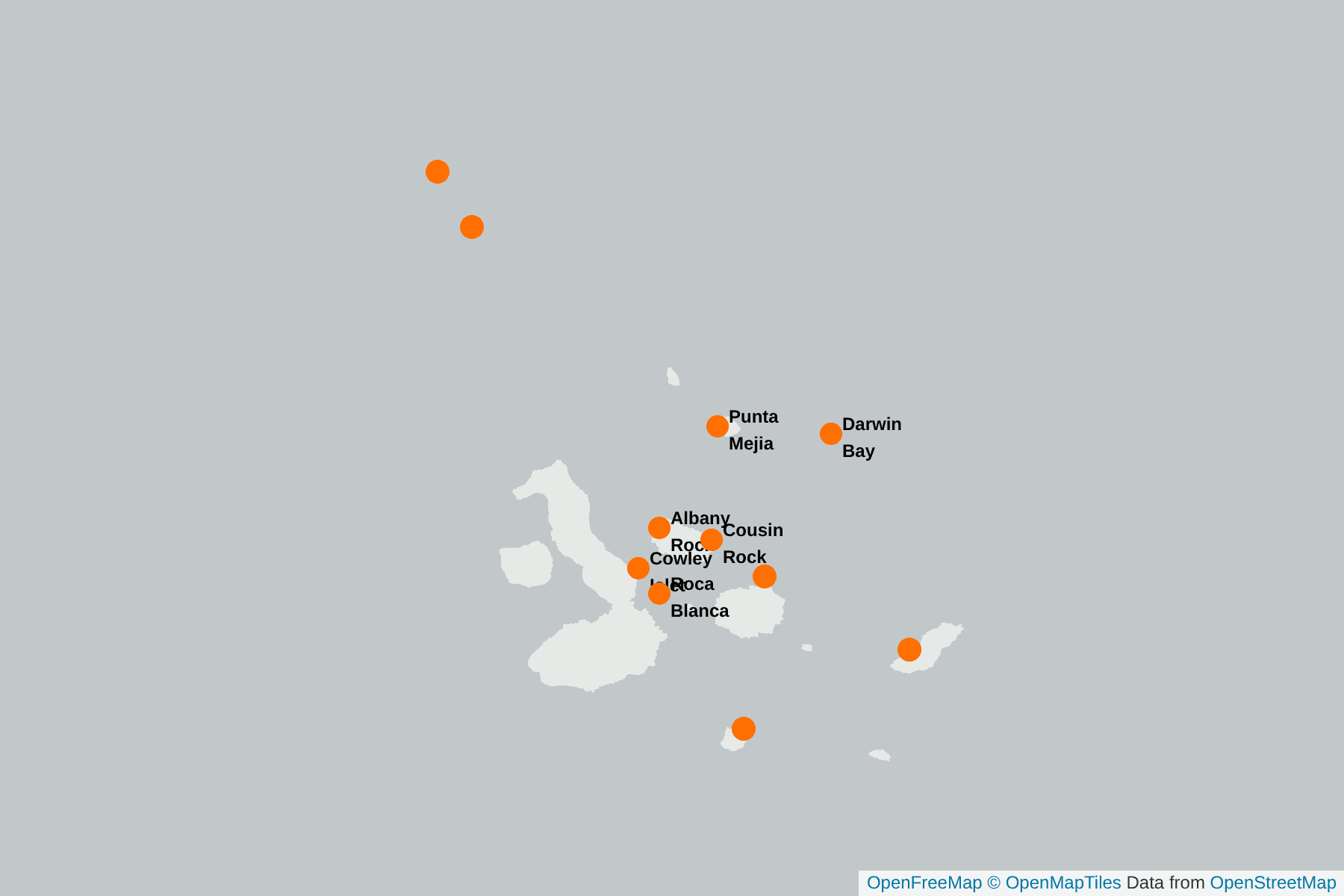
Highlights where the Galapagos Sharks can be seen

Albany Rock
Albany Rock

Albany Rock is a small crescent-shaped outcrop just off the northwest coast of Santiago Island.

The dive at Albany has a maximum depth of around 100ft and visibility here is from 40 – 70 feet, depending on time of year. There's a moderate current that shifts from north to south with the tides, and also some moderate surge.

This is a great dive site to swim with Galápagos Sea Lions who often come and say hello. There are a host of tropical fish to be seen here, as well as species such as manta and stingrays, Galápagos green turtles and several species of sharks. The rocky bottom and geological formations provide a great habitat for a wide variety of marine life and make for enjoyable exploring under water.

Carrion Point
Carrion Point

Carrion Point on the eastern coast of Santa Cruz protrudes into the ocean, creating a sheltered cove which is a superb place to snorkel.

There's no landing here, you can simply dive into the water from your boat. The sheltered waters are crystal clear and you will see a wide range of marine wildlife, including Galápagos rays, sharks, and innumerable tropical fish.

A panga ride along the coast here will also allow your Galapatours guide to tell you more about the bird species and about the ecology of this part of Santa Cruz in general.

Humboldt Explorer Galapagos Diving Cruise
Carrion Point Dive Site

Carrion Point is often used as a dive site before the long trip north to Wolf and Darwin Islands, so you may have your first "proper" Galápagos dive here.

The site is typical of the Galápagos, with rocky slopes and a boulder-strewn reef with only ocasional patches of sand. The habitat is very rich here, and you are likely to encounter a wide range of tropical fish, as well as hammerhead sharks, reef sharks, manta rays, as well as the ever-curious Galápagos Sea Lions.

Champion Islet
Champion Islet

Champion Islet is considered one of the best snorkeling sites in the entire archipelago. This small island was originally named after a famous whaler, Andrew Champion, and in its beautiful waters you can see Galápagos Sea Lions, Green Turtles, Hammerheads, Rays, and many colorful reef fish.

Champion Islet isn't only for those who seek out marine life. On shore you can find Galápagos Penguins, Blue-Footed Boobies and Frigatebirds to name but a few. One very special resident is the Floreana Mockingbird. This species is extremely rare, with only an estimated 100 individuals left - of which only 30-40 of them are left on this island. It is unknown how much longer this fragile species can survive.

Cousin Rock
Cousin Rock

This is a famous site thanks to the wide variety of marine life you can encounter in just one dive, but it is for moderate to advanced divers only. Depths range from 10 to 90ft, with visibility between 30 and 60ft depending on the season. Currents here are moderate, and surges will be experienced in the shallows.

In the water you'll encounter sloping rock plate formations and a fantastic wall that drops far down out of sight. These rocky formations are home to seahorses, Galápagos black coral, octopus, a wide range of tropical fish and Galápagos sharks and hammerheads.

When you add to this the friendly sea lions who almost always come to play with divers and the elegant green turtles that cruise past, this dive site really does have it all.

Cowley Islet
Cowley Islet

This islet off the coast of Isabela is a popular diving site thanks to the variety of species that you can see in the waters here. In or on the water you are likely to encounter a range of shark species, Galápagos sea lions, stingrays, green sea turtles, cormorants, penguins, manta rays, and many more.

Also visible in these habitats are sponges and corals, and if you are lucky even sea horses, shaped just like the island of Isabela herself!

If you have any particular species that you are keen to see on your dive, contact one of our Galápagos experts today and we can advise on the best dive itinerary to suit your requirements.

Daphne Major
Daphne Major

Daphne Major (or Mayor) is a barren, tree-less island that is the remains of an extinct tuff cone whose rim rises some 400ft above sea level.

A trip around this island by boat offers the opportunity for some excellent snorkeling as well as observing the many seabirds that hunt in the area.

While snorkeling near Daphne Major you will be able to see many species of tropical fish, as well as rays, green turtles, shark species and more.

Darwin Bay
Darwin Bay

Darwin Bay is a must-visit site for birdwatchers. Starting with a landing on a beautiful white coral beach you are able to follow an easy half-mile trail that will take you through bird-filled mangroves. Species that can be seen on this part of the trail include Nazca Boobies, Galápagos red-footed Boobies, and Swallow-Tailed gulls.

As the path continues you will find tidal pools - favourite spots for Galápagos Sea Lions to lazily swim and play. At the path's end you will come to the top of a cliff which will reward you with a spectacular view.

Darwin's Arch / Towers Diving
Darwin's Towers

Huge schools of hammers and Galápagos sharks, whale sharks, Mantas: Darwin's Towers (formerly: Darwin's Arch) is arguably one of the world's best diving sites.

Located just off the southeast tip of Darwin Island, the islet of Darwin's Towers (formerly known as Darwin's Arch, but the arch collapsed in 2021) is a fantastic marine wonderland. The main attractions are the whale sharks and hammerhead sharks that often gather here. But there are many other species you can find - green turtles, majestic manta rays, dolphins, large schools of fish, and other species of sharks are all frequent encounters.

We have met divers with over 1000 logged dives that still called it the single best diving site of their life! If you have any particular species that you are keen to see on your dive, contact one of our Galápagos experts today, and we can advise on the best dive itinerary to suit your requirements.

Devil's Crown
Devil's Crown

Once a volcanic crater, the Devil's Crown is now what remains of the eroded crater. The wind and waves have breached the east and west walls, leaving just the northern and southern crater edges showing above the water. Over thousands of years a coral reef has grown in the submerged center, creating one of the best snorkeling sites on the entire Galápagos.

Exposed to currents, snorkeling in the Devil's Crown isn't a sedentary experience, and the surges can be quite thrilling! The marine life you will see is unparalleled, with colorful reef fish, sharks, rays and more. If your itinerary includes a stop here, you really must get into the water as it's an experience not to be missed.

Fondeadero
Fondeadero

This is one of the only places in the whole Galápagos where night diving is allowed. Fondeadero means "anchoring site", and it's well names - this is the perfect place for a night dive as it's protected from the winds and currents. This makes it possible to enjoy night diving, and to witness a whole new side to Galápagos' undersea world.

Highlights to a night dive here include the chance of seeing the see glow gently with an eerie light, thanks to the bioluminescence of tiny plankton in the water when conditions are right. You've also got an excellent chance of being joined by Galápagos Fur Seals on your dives here.

Galapagos Sea Lion
Isla Lobos Dive Site

One of the best spots in Galápagos to observe sea lion pups, trumpet fish and blue footed boobies.

Lobos Island is named after the colony of Galápagos Sea Lions that live here, but they aren't the only native Galápagos species that calls this narrow island home. In the water, you will find Fur Seals fishing Blue-Footed Boobies, Trumpet Fish, Green Turtles, Rays and white-tip reef sharks. With a bit of luck, you might also spot marine iguanas, although they are not hugely common here!

Kicker Rock
Kicker Rock

Kicker Rock (or Leon Dormido, "sleeping lion", locally) is an iconic feature of Galápagos geology, and is one of the most popular photograph opportunities in the archipelago.

Kicker Rock is the remains of a volcanic "tuff cone". Tuff cones are formed when hot magma meets cold seawater, and the resulting explosion forms the rocky structure seen today. Over countless years erosion has caused a split, opening a narrow channel that small boats can sail completely through, and offering an amazing view as you sail around this 490ft tall monolith!

As you navigate around the rock you will see Galápagos Blue-Footed Boobies, Nazca Boobies, and Frigatebirds as they launch themselves from their roosts in the cliffs high above.

Darwin's Arch / Towers Diving
Main Darwin Island

Darwin Island (originally named Culpepper Island) was renamed in honor of the famous naturalist. It is considered by many to be one of the best underwater habitats anywhere on earth.

Darwin is the most northerly island in the Galápagos, and is over 100 miles northwest of Isabela. Together with its neighbour Wolf Island, it is the most remote part of the archipelago.

Renowned for the large schools of hammerhead sharks that gather here (for reasons scientists still don't fully understand), Darwin and Wolf are tips of huge long-extinct undersea volcanoes that grew up over half a mile from the seafloor below.

You will enjoy spectacular diving here, and among the species you are likely to encounter are hammerhead sharks, whale sharks, rays, green turtles, and a myriad of tropical reef fish. If you have any particular species that you are keen to see on your dive, contact one of our Galápagos experts today and we can advise on the best dive itinerary to suit your requirements.

Mosquera Diving Point

Mosquera, like may similar islets in the Galápagos, was formed by a volcanic uprising. The islet Mosquera that emerges from the sea between Seymour and Baltra island. A sandy bottom at 15-18 meters is scattered with curious garden eels and pelagic species as well as an underwater wall flowing downwards from the shallows into the deep. Keep an eye out for hammer head sharks and the garden eels that pop their heads out of the ground and disappear down their burrow as you approach! Also found in the area are black tip and white tip reef sharks, sea lions, turtles, barracudas, sting rays, eagle rays, mobula rays, Galápagos eels and a variety of reef fish and invertebrates.

Mosquera is home to one of the largest populations of Galápagos Sea Lions on the archipelago, and you will be able to watch their playful antics and admire their sense of relaxation as they sunbathe on the beach. There have been occasional sightings of Orca (Killer Whales) in the waters off Mosquera Island, probably attracted by the large number of Galápagos Sea Lions on which they prey.

Over the centuries it also attracted corals, and along with the rocks that form the islet this helped to capture the sand from the currents that flow between Baltra Island and North Seymour Island.

Mosquera Islet has a depth range between 6 – 27 meters (20 – 90 feet). Visibility averages 12 – 15 meters (40 – 50 feet). Surge and current is usually moderate to strong.

Mosquera Islet
Mosquera Islet

Mosquera Islet, like may similar islets in the Galápagos, was formed by a volcanic uprising. Over the centuries it also attracted corals, and along with the rocks that form the islet this helped to capture the sand from the currents that flow between Baltra Island and North Seymour Island.

Mosquera is home to one of the largest populations of Galápagos Sea Lions on the archipelago, and you will be able to watch their playful antics and admire their sense of relaxation as they sunbathe on the beach.

There have been occasional sightings of Orca (Killer Whales) in the waters off Mosquera Island, probably attracted by the large number of Galápagos Sea Lions on which they prey.

North Islet / La Banana

North Islet is a small outcrop just off the north coast of Wolf, and because of the wall's shape it's known to locals as "the banana"!

This is a stunning sheer wall with caverns, tunnels and other wonderful rock formations. Depth here ranges from 30 to 120ft and the visibility is usually excellent, varying from 40 to 80ft depending on season. There is always a moderate to heavy current here.

A superb site for spotting Galápagos sharks, hammerheads, manta rays, green turtles and a wide range of fantastic Galápagos marine life.

Punta Mejia
Punta Mejia

Marchena is the largest of the northern Galápagos Islands, but with no land-based visitor sites it is rarely seen by anyone - even scientists and National Park Wardens are very infrequent visitors.

The main attraction here is the snorkeling off Marchena's coast. The deep, clear waters and calmer seas here make exploring this undersea world a magical experience.

There is a huge variety of tropical fish at Punta Mejia, and when you go into the water accompanied by your Galapatours expert guide you are also likely to see rays, a variety of sharks, and green sea turtles to name but a few.

Roca Blanca
Roca Blanca

Only available since 2012, this site is rarely visited by divers and is recognized for wonderful encounters with six different species of shark, manta & eagle rays, sea lions, moray eels, lobsters, and a prolific population of “tropicals”.

For divers, Roca Blanca is one of our top "secret sites" - it's a mecca for sea life, rather like the Arch at Darwin Island. Located on the southeast coast of Isabela Island, this site promises some of the very best diving the central islands has to offer. Waters in this part of Galápagos are cooler and more nutrient rich than the areas of Wolf and Darwin. This increases the diversity and intensity of marine life.

Most unusually, the dive site at Roca Blanca also sometimes provides you with the remarkable opportunity to encounter enormous "bait balls" with marauding billfish in action. This is truly spectactular Galápagos diving!

Shark Bay Diving Galapagos
Shark Bay

Shark Bay at Wolf Island is an underwater visitor point well known as being among THE best dive sites in Galápagos to see Hammerheads and Galápagos Sharks. Whale sharks have alse been encountered here, as well as a huge range of fish, rays, turtles, marine mammals and many more iconic Galápagos creatures.

The Cave Dive Site
The Cave Dive Site

The Cave is a well known as being among THE best diving sites in Galápagos to see Hammerheads and Galápagos Sharks. Whale sharks have alse been encountered here, as well as a huge range of fish, rays, turtles and many more iconic Galápagos creatures here at the iconic Wolf Island.

The Landslide Dive Site

El Derrumbe is particularly well known as THE dive in Galápagos to see Hammerheads and Galápagos Sharks. Whale sharks have alse been encountered here, as well as a huge range of fish, rays, turtles, marine mammals and many more iconic Galápagos creatures.

Our trips to spot the Galapagos Sharks

Hitomi

Your contact

Hitomi

Call now

+1 347-674-0913

Weekdays from 15:00 to 20:00 CET

​
​
​
​
​
​
Hitomi