%3Aformat(webp)%2Fgal%2Fdestination%2F20170225_Day_5_Fernandina_Punta_Espinosa_Isabela_Urbina_Bay_297_of_473.jpg&w=1920&q=75)
Fernandina Island, Galapagos
Untouched Volcanic Beauty
What you need to know about Fernandina Island, Galápagos
The youngest and most pristine of the Galápagos Islands, Fernandina is a favorite place to visit for Galapatours clients. Thanks to the rich, cold water currents that surround her, she's home to many wonderful species, including flightless cormorants, Galápagos Penguins, and land and marine iguanas.
The third largest island in the archipelago, she first appeared on hand-made maps by the British buccaneer Ambrose Cowley in 1684. He named her Narborough Island, but her Spanish name, Fernandina, was given to honour King Fernando of Spain, most famous as the sponsor of the voyages of Christopher Columbus to the New World. Fernandina is the Galápagos’ most volcanically active island and her last eruption was records less than 10 years ago. Many early visitors to the Galápagos Islands commented on Fernandina’s dramatic changes of landscape, her smoking craters, and tales of violent volcanic eruptions. The reason for all this activity is that she sits right over the centre of the volcanic hotspot that's responsible for creating the entire Galápagos archipelago.
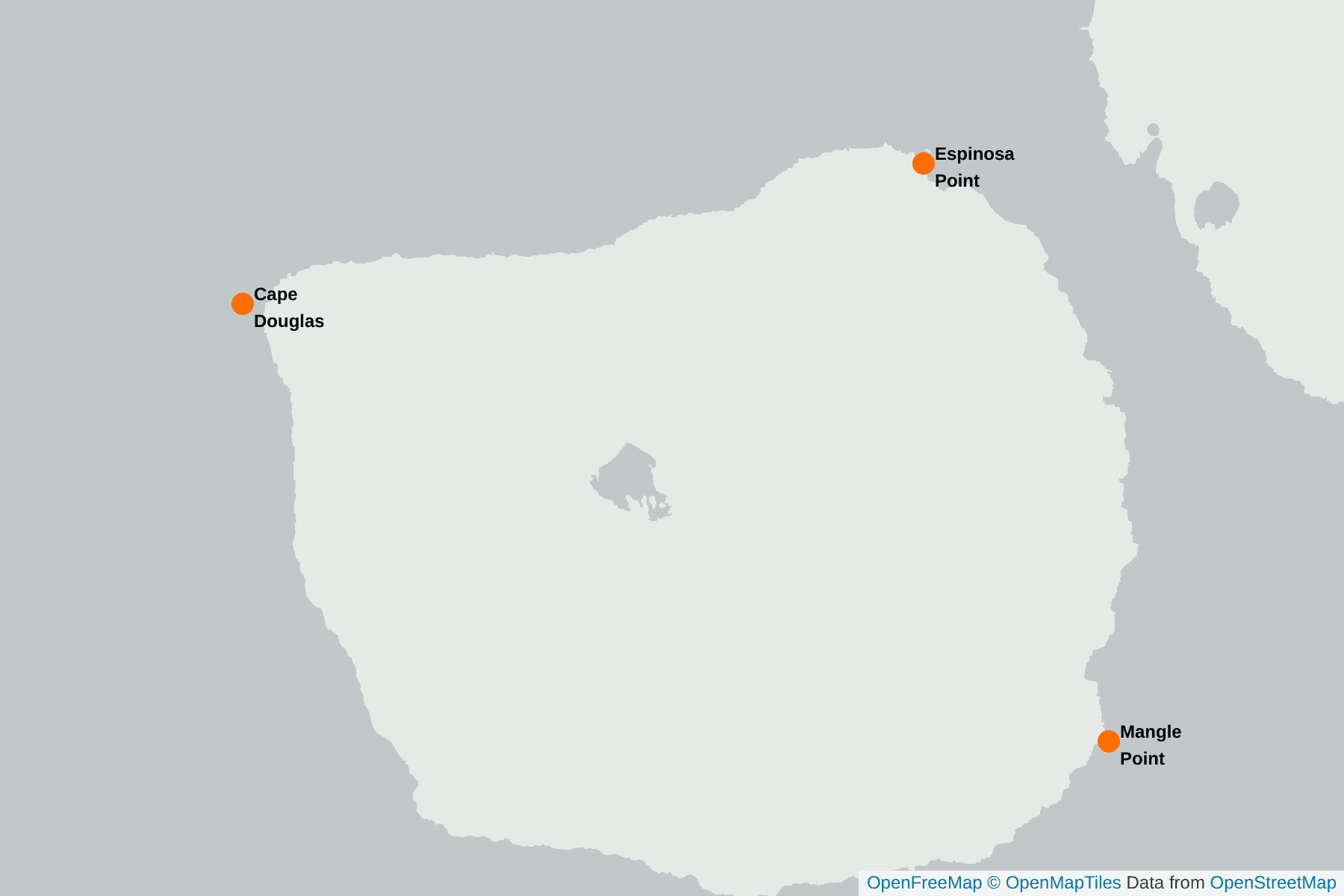
Fernandina's volcano is known as La Cumbre, and the summit crater is an amazing 6.5km across. Recent eruptions have occurred both inside the crater and on the outer slopes, with some lava reaching the sea. Since the Galápagos National Park was formed there have been 13 eruptions on Fernandina, some of them continuing for several days. The National Park keeps Fernandina perfectly undisturbed, except for a single visitor site on the northeastern shore (Espinosa Point). The island is home to a large land iguana population, and they even nest in the volcanic crater. The waters surrounding Fernandina are among the richest in the whole Galápagos thanks to the rising of the cold water Cromwell Current that hits the westerly part of the island. This creates a superb feeding habitat for species like the Flightless Cormorant and Galápagos Penguins.
Interesting facts about Fernandina
The most geologically active island, her volcano last erupted less than 10 years ago
A perfect feeding ground for Galápagos Penguins and Flightless Cormorants
This pristine island is kept in perfect condition by the National Park
Land Iguanas nest in the warm volcanic caldera
Pictures of Fernandina

%3Aformat(webp)%2Fgal%2Fdestination%2F20170225_Day_5_Fernandina_Punta_Espinosa_Isabela_Urbina_Bay_279_of_473.jpg&w=1920&q=75)
+41
%3Aformat(webp)%2Fgal%2Fdestination%2F20170225_Day_5_Fernandina_Punta_Espinosa_Isabela_Urbina_Bay_280_of_473.jpg&w=1920&q=75)
Our highlights in Fernandina
%3Aformat(webp)%2Fgal%2Fhighlight%2F20170225_Day_5_SAMBA_Fernandina_Punta_Espinosa_Isabela_Urbina_Bay_294_of_473.jpg&w=1920&q=75)
%3Aformat(webp)%2Fgal%2Fhighlight%2Fmangle-point.jpg&w=1920&q=75)
%3Aformat(webp)%2Fgal%2Fhighlight%2Fmarine-iguana.jpg&w=1920&q=75)
%3Aformat(webp)%2Fgal%2Fanimal%2Fblue-footed-boobie.jpg&w=1920&q=75)
%3Aformat(webp)%2Fgal%2Fanimal%2FBrown_Pelican_181_of_240__1.jpg&w=1920&q=75)
%3Aformat(webp)%2Fgal%2Fanimal%2Fgalapagos-finches-3.jpg&w=1920&q=75)
%3Aformat(webp)%2Fgal%2Fanimal%2Fflightless-cormorant-1.jpg&w=1920&q=75)
%3Aformat(webp)%2Fgal%2Fanimal%2FDove_227_of_240_.jpg&w=1920&q=75)
%3Aformat(webp)%2Fgal%2Fanimal%2Ffrigate-bird-2.jpg&w=1920&q=75)
%3Aformat(webp)%2Fgal%2Fanimal%2Fgalapagos-fur-seal-1.jpg&w=1920&q=75)
%3Aformat(webp)%2Fgal%2Fanimal%2FSky_76_of_82_.jpg&w=1920&q=75)
%3Aformat(webp)%2Fgal%2Fanimal%2Fgalapagos-hawk-2_1.jpg&w=1920&q=75)
%3Aformat(webp)%2Fgal%2Fanimal%2FLava_Heron_50_of_240_.jpg&w=1920&q=75)
%3Aformat(webp)%2Fgal%2Fanimal%2FLava_Lizard_192_of_240_.jpg&w=1920&q=75)
%3Aformat(webp)%2Fgal%2Fanimal%2F20170225_Day_5_Fernandina_Punta_Espinosa_Isabela_Urbina_Bay_280_of_473.jpg&w=1920&q=75)