Galapatours logo 1200px svg

Bestseller

All Dates & Prices

Cruises

Galapagos

Info

Home

Bestseller

Galapatours

Full Loop NW+SE

Galapatours

Western Galápagos Cruise

Galapatours

Genovesa & Southeast Galápagos

Galapatours

Complete Loop of the Galápagos

Galapatours

Central, Eastern & Southern Islands

Galapatours

Western Islands Galápagos

All Dates & Prices

Cruises

Information

Diving Cruises

For Families

For Solo Travelers

Gay & LGBT Cruises

Last Minute Offers

Our Selection Of The Best Routes

Ship Type

All ships & How to pick the best

Larger Ships (>50 Passengers)

Motor Catamarans

Sailing Catamarans

Sailing Yachts

Yachts

Travel Style

Budget Cruises

Classic Cruises

Premium Cruises

Luxury Cruises

Galapagos

Bartholomew

All Islands and Highlights

GAL Guidebook eBook

Free Guidebook Download

Galapagos Giant Tortoise

Galapagos Wildlife Guide

Monserrat Exterior

Sustainable Tourism

Weather in the Galapagos

YouTube Thumbnail Galapatours Menu

YouTube: Galapagos Expert Talks

Info

Information

What our travelers say

Add-Ons

Answers to over 80 FAQ

Flights

Travel Insurance for EU and CH Residents

Your Advantages When Booking With Us

Free Hotel Night Before Tour

Unbiased Recommendations

A Team of Galapagos Specialists

Flexible Booking Conditions

No Hidden Fees

Your money is protected

Contact us

Weekdays from 9:00 to 14:00 EST

$
​
​
$
​
​

Sign up for our Galapagos newsletter

Get travel inspiration and exclusive deals delivered straight to your inbox.

​
Galapatours logo 1200px svg

Budget Ships

Aida Maria

Angelito

Aqua

Danubio Azul

Golondrina

Nemo I

Classic Ships

Aggressor III

Anali

Archipel I

Beagle

Bonita

Eden

Estrella del Mar

Premium Ships

Anahi

Angel

Beluga

Cachalote Explorer

Calipso

Coral I + II

Eco Galaxy

Luxury Ships

Alia

Aqua Mare

Cormorant II

Elite

Endeavour II

Endemic

Evolution

Further Cruise Links

The Best Galapagos Cruises

Galápagos Honeymoon Cruises

Galápagos Cruises with French Speaking Guides

Galápagos Cruises with German Speaking Guides

4 Day Galápagos Cruises

5 Day Galápagos Cruises

7 Day Galápagos Cruises

Further Information

About Galapatours

B2B Deals

Careers

Join our team!

Terms & Conditions

ventura TRAVEL

Reservations

🇺🇸 +1 347 674 0913

🇬🇧 +44 20 4525 9654

🇩🇪 +49 30 30809199

🇫🇷 +33 1 86 26 29 65

Contact Form

service(at)galapatours.com

Weekdays from 9:00 to 14:00 EST

Red-Footed Booby

Red-Footed Booby

The nocturnal hunter who's rarely seen

What you need to know about the Red-Footed Booby

The Red-Footed Booby is certainly not easily mistaken for any of the other booby species, thanks to those big crimson webbed-feet! They are the most numerous of the Galápagos booby species, but they are actually one of the most rarely seen by our visitors because of certain aspects of their lifestyle.

First of all, Galápagos Red-Footed Boobies actually nest in colonies amongst the trees, as opposed to the other Booby species who nest on the ground. This makes them more difficult to spot than their cousins and makes it virtually impossible to see them without actually going ashore.

The other aspect to their behaviour that makes them less likely to be encountered is that they are semi-nocturnal, and they tend to spend part of the night feeding in the waters right at the edge of the Galápagos archipelago, leading them to prefer to nest in the outlying islands.

At Galapatours, we offer a wide range of cruise itineraries, including those that take in these more remotes islands such as Genovesa and San Cristóbal - so if the Red-Footed Booby is on your list of “must sees” speak to one of our Galápagos experts who can show you the wildlife cruises that will visit the nesting areas of these beautiful animals.

Interesting facts about Red-Footed Booby

Red-Footed Boobies get the pigmentation in their legs and feet from compounds called carotenoids found in their seafood diet

This is the smallest of all the booby species

Although superb long-distance fliers, Red-Footed Boobies are not great at taking off without any wind to help!

Although not currently endangered, Red-Footed Boobies are vulnerable to habitat destruction and predation from non-native species

Pictures of Red-Footed Booby

Red-Footed Booby
Red-Footed Booby
+2
Red-Footed Booby

Highlights where the Red-Footed Booby can be seen

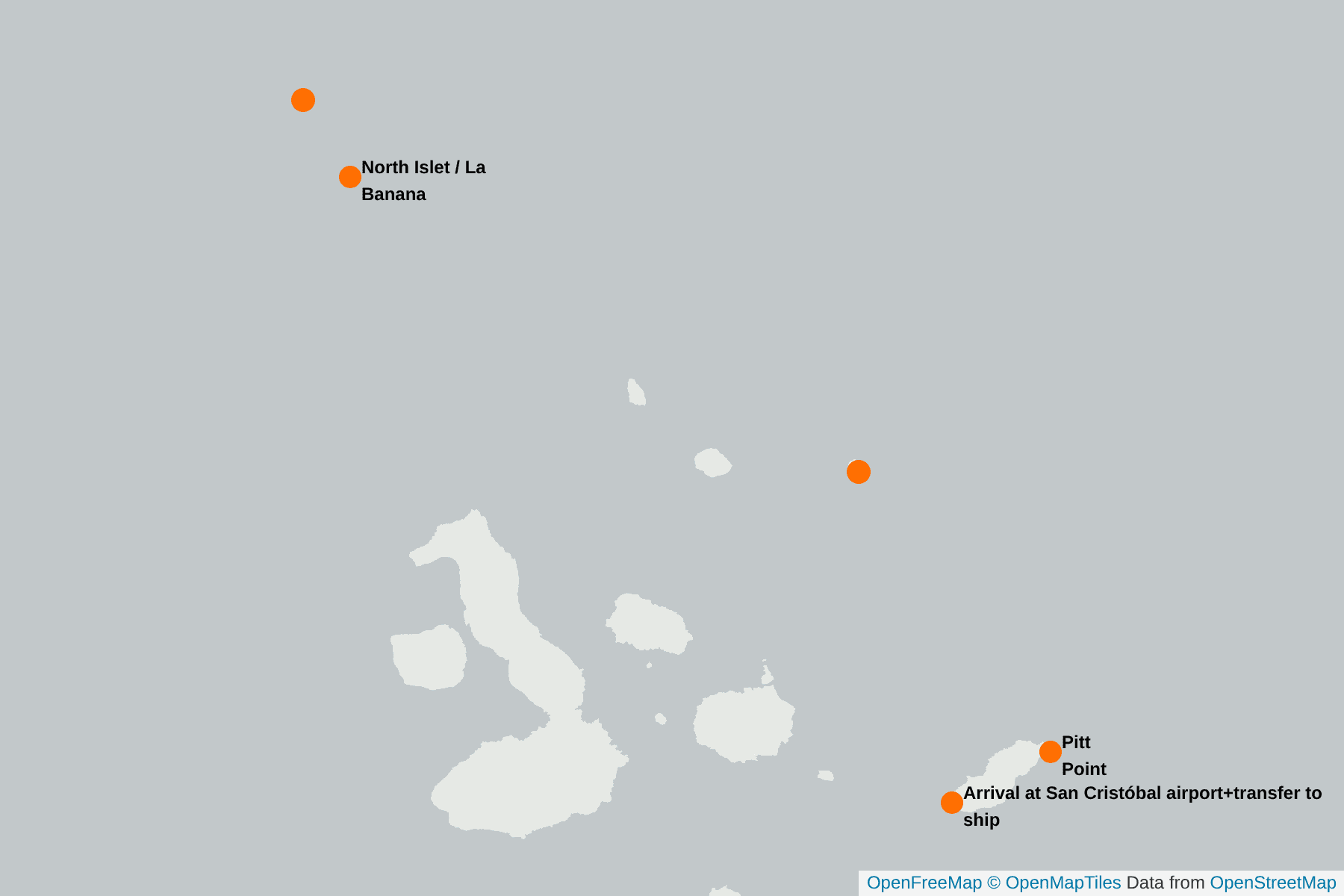
Arrival at San Cristóbal airport + transfer to ship (organized)
Arrival at San Cristóbal airport+transfer to ship

Welcome to Galápagos! After your flight lands, and you have completed the immigration process, our English-speaking guide will meet you in the Arrivals lounge if you booked your flight tickets with us for the same cruise dates. The guide will then escort you to your transfer vehicle for a short journey to your waiting ship.

If you did not book your flight tickets with us, your voucher will specify the meeting point & time. Please note that the transfer to the meeting point is not included.

San Cristobal is home to the official capital city of the Galápagos, Puerto Baquerizo Moreno, and one of the archipelago's 2 airports. We don't know of any other airport where jet airliners land that is within walking distance of the town it serves, as is the case here on San Cristobal - you can stroll to the centre of town from the terminal in 15 minutes!

Once on board your ship, you will be introduced to the crew and given a welcome briefing as well as an important safety drill. After this you'll be shown to your cabin. While you're served a well-deserved and delicious lunch, the captain will cast off and your adventure truly starts.

Note: If you are already in San Cristóbal before the cruise and want to meet the group there, please let us know. This is no problem at all and the transfer from Puerto Baquerizo Moreno and back couldn't be easier.

Darwin Bay
Darwin Bay

Darwin Bay is a must-visit site for birdwatchers. Starting with a landing on a beautiful white coral beach you are able to follow an easy half-mile trail that will take you through bird-filled mangroves. Species that can be seen on this part of the trail include Nazca Boobies, Galápagos red-footed Boobies, and Swallow-Tailed gulls.

As the path continues you will find tidal pools - favourite spots for Galápagos Sea Lions to lazily swim and play. At the path's end you will come to the top of a cliff which will reward you with a spectacular view.

Darwin's Arch / Towers Diving
Darwin's Towers

Huge schools of hammers and Galápagos sharks, whale sharks, Mantas: Darwin's Towers (formerly: Darwin's Arch) is arguably one of the world's best diving sites.

Located just off the southeast tip of Darwin Island, the islet of Darwin's Towers (formerly known as Darwin's Arch, but the arch collapsed in 2021) is a fantastic marine wonderland. The main attractions are the whale sharks and hammerhead sharks that often gather here. But there are many other species you can find - green turtles, majestic manta rays, dolphins, large schools of fish, and other species of sharks are all frequent encounters.

We have met divers with over 1000 logged dives that still called it the single best diving site of their life! If you have any particular species that you are keen to see on your dive, contact one of our Galápagos experts today, and we can advise on the best dive itinerary to suit your requirements.

Darwin's Arch / Towers Diving
Main Darwin Island

Darwin Island (originally named Culpepper Island) was renamed in honor of the famous naturalist. It is considered by many to be one of the best underwater habitats anywhere on earth.

Darwin is the most northerly island in the Galápagos, and is over 100 miles northwest of Isabela. Together with its neighbour Wolf Island, it is the most remote part of the archipelago.

Renowned for the large schools of hammerhead sharks that gather here (for reasons scientists still don't fully understand), Darwin and Wolf are tips of huge long-extinct undersea volcanoes that grew up over half a mile from the seafloor below.

You will enjoy spectacular diving here, and among the species you are likely to encounter are hammerhead sharks, whale sharks, rays, green turtles, and a myriad of tropical reef fish. If you have any particular species that you are keen to see on your dive, contact one of our Galápagos experts today and we can advise on the best dive itinerary to suit your requirements.

North Islet / La Banana

North Islet is a small outcrop just off the north coast of Wolf, and because of the wall's shape it's known to locals as "the banana"!

This is a stunning sheer wall with caverns, tunnels and other wonderful rock formations. Depth here ranges from 30 to 120ft and the visibility is usually excellent, varying from 40 to 80ft depending on season. There is always a moderate to heavy current here.

A superb site for spotting Galápagos sharks, hammerheads, manta rays, green turtles and a wide range of fantastic Galápagos marine life.

Pitt Point
Pitt Point

Pitt Point, or Punta Pitt, is at the far eastern edge of San Cristobal. Following a wet landing directly onto the beach you'll be welcomed by the friendly and noisy barking of the local colony of Galápagos Sea Lions! This is actually a bachelor colony of males who haven't held a breeding territory, and they can sometimes be the worse for wear if they have been fighting on one of the breeding beaches elsewhere.

After the noise of the beach, a quieter path takes us up the cliffs to a breeding site used by all 3 resident species of booby - the Blue-Footed, Red-Footed and Nazca Boobies. Nowhere else in the Galápagos do all three species nest side-by-side like this.

As well as this unique booby colony you can also see Galápagos Frigatebirds and petrels. In addition to the wonderful bird life, the view down to the beach and across the island from this high vantage point make the climb worth it.

The hiking trail lets you get a close look at the Saltbush and other tough shrubs that manage to survive in this sometimes eerie volcanic landscape. Your Galapatours guide will be able to explain in detail how hardy plants such as these colonise the lava fields all over the Galápagos.

Prince Philip's Steps

Named after Prince Philip, the husband of Queen Elizabeth II, who visited the Galápagos Islands twice, the Prince Philip's Steps pier uses natural rock formations to allow you to land and admire the variety of seabirds that inhabit Genovesa. With careful steps on the wet and slippery lower rocks, you begin your hike near a small colony of Galápagos sea bears before reaching the beautiful vantage point further up with views of the lava plains.

The birdlife will surround you from all sides and you will enjoy the sight and sounds of many wonderful species, including blue-footed boobies, red-footed boobies and Nazca boobies, but also small Galápagos owls and Galápagos pigeons.

Our trips to spot the Red-Footed Booby

Hitomi

Your contact

Hitomi

Call now

+1 347-674-0913

Weekdays from 9:00 to 14:00 EST

​
​
​
​
​
​
Hitomi